

About VITAL

The project, its objectives, methodology, work packages and the consortium behind it - all in one place.

Project overview

A strategic initiative for faculty development

VITAL - Virtual Innovation and Training for Advancing Faculty Leaders, Digital Competencies, and Research Excellence - is a 36-month capacity-building project funded by the European Union. It empowers early-career faculty in Georgian and Ukrainian higher education institutions by closing long-standing gaps in mentorship, academic leadership, digital pedagogy and research development.

Programme

Erasmus+ Virtual Exchange - Neighbourhood East, managed by the European Education and Culture Executive Agency (EACEA).

Project number

101253516 · ERASMUS Lump Sum Grant.

Duration

February 2026 - January 2029 · 36 months.

Coordinator

Universidade de Santiago de Compostela (USC), Spain.

Consortium

6 partners in 4 countries: Spain, Italy, Georgia and Ukraine.

Budget

500,000 EUR total EU contribution.

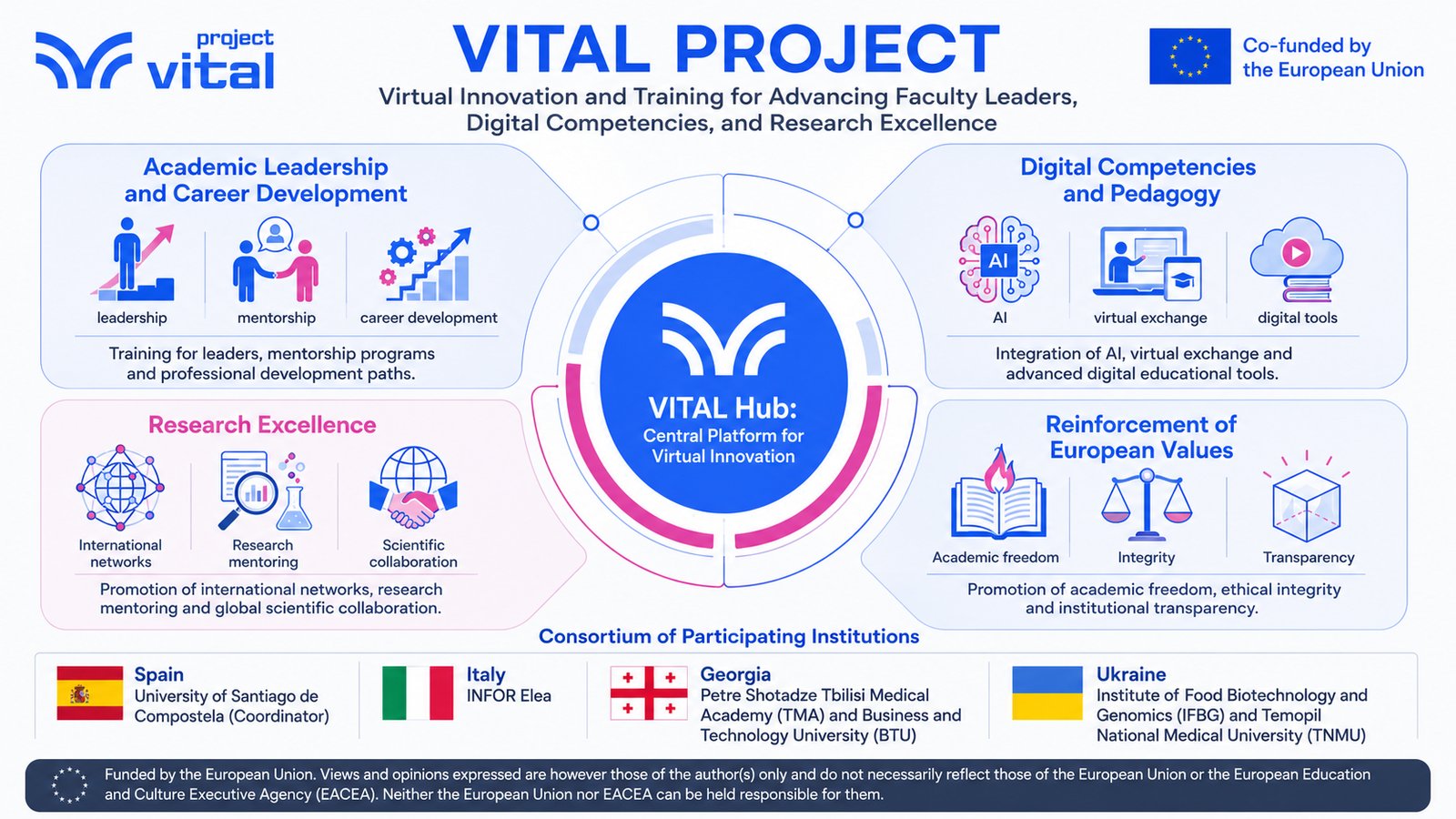
Graphical abstract of the VITAL project: European and Eastern-partner institutions co-create mentorship, digital pedagogy training and research capacity-building for early-career faculty in Georgia and Ukraine
The VITAL project at a glance: co-created training, mentorship and research excellence across six institutions.
Context & relevance

Why VITAL?

Early-career academics in Georgia and Ukraine work in environments still shaped by post-Soviet academic legacies: hierarchical governance, limited access to career development and insufficient institutional support for pedagogical and research innovation.

Mentoring programmes are rare, research investment is low, and the regional context has made virtual teaching and collaboration tools critical for continuity. VITAL responds with a sustainable, scalable faculty-development framework grounded in European values - co-created with the institutions it serves rather than imported from outside.

A team of young academics gathered around a laptop, working together

In Georgia

Research investment remains persistently below 0.5% of GDP, structured professional development is scarce, and early-career faculty hold little decision-making power - fuelling a real risk of brain drain.

In Ukraine

The war has displaced more than 665,000 students and 25,000 faculty and damaged over 3,798 educational institutions - yet Ukrainian institutions hold 172 Horizon Europe projects, a testament to remarkable academic resilience.

Objectives

Four strategic objectives

01

Strengthen career development

Soft-skills and academic leadership training tailored to early-career faculty, a co-created Leadership and Soft Skills Competency Framework, and 1:1 mentorship pairs connecting EU and local academics.

02

Enhance digital pedagogy capacity

Training in digital and AI-integrated pedagogy and hybrid teaching design, powered by virtual exchange and the interactive VITAL Hub for continuous faculty development.

03

Advance research capacity

Research methodology workshops, co-authorship opportunities, peer mentorship and a Training-of-Trainers cascade that turns participants into research facilitators for their institutions.

04

Promote European values

Academic freedom, transparent leadership, research ethics and integrity training, and inclusive leadership frameworks integrated into institutional policy.

Target groups

Who VITAL is for

Early-career faculty & researchers

The primary group: lecturers and researchers gaining leadership and soft-skills training, EU mentorship and AI-enhanced digital pedagogy.

Mentors & trainers

Experienced academics who develop mentoring and Training-of-Trainers skills - and take on lasting new roles in faculty development.

Institutional leaders

Deans, rectors and HR teams receiving diagnostics, policy tools and EU guidance to embed faculty development into institutional structures.

Networks & decision-makers

The wider European higher-education community and national authorities, who gain replicable tools and evidence for policy uptake.

Methodology

How VITAL works

An iterative cycle - diagnose, enhance, refine, embed - delivered through five practical steps and co-created between EU and Eastern partners at every stage.

Identify needs

Mixed-method needs assessment and institutional diagnostics across Georgian and Ukrainian HEIs - over 1,200 responses targeted.

Co-design

Competency framework, training curricula and mentorship models co-created by all six partners.

Train & mentor

Two training rounds in leadership, digital pedagogy and research, with 1:1 mentorship and the VITAL Hub at the core.

Refine

A second needs assessment and participant feedback drive revision and re-testing of every module and toolkit.

Embed & sustain

Tools formally integrated into HR and faculty-development policies, backed by MoUs and sustainability plans.

Expected impact

Change at every level

Individual

300+ faculty complete the full training cycle, with 85% expected to report measurable gains in leadership, digital or research competencies.

Institutional

At least three universities formally embed the Competency Framework and mentorship model into HR and faculty-development policies.

Scientific

Research workshops and a Training-of-Trainers cascade lead to at least two joint publications and lasting peer-led research support.

International

More than 2,000 participants engaged, stronger integration into the European Higher Education Area, and a replicable model for the Eastern Partnership and post-crisis settings.

Timeline

Key milestones, 2026-2029

February 2026 · Month 1

Kick-off meeting in Tbilisi

The consortium launches the project, hosted by TMA, and aligns the mentorship and Training-of-Trainers strategies.

September 2026 · Month 8

Competency Framework published

The co-created VITAL Leadership and Soft Skills Competency Framework is finalised and released.

November 2026 · Month 10

VITAL Hub launch

The online faculty development platform goes live with the first training resources.

April 2027 · Month 15

Round I training completed

First round of leadership and soft-skills training delivered across the partner institutions.

July 2027 · Month 18

Midterm Conference

The consortium meets in Tbilisi to share interim results, alongside the midterm evaluation.

November 2027 · Month 22

Peer mentorship piloted

The 1:1 peer mentorship programme runs with EU-local pairs, and the digital pedagogy and AI modules are completed.

March 2028 · Month 26

Research workshops delivered

Workshops on research design, academic writing, open science and grant development conclude.

November 2028 · Month 34

Final Conference

The final multiplier conference takes place in Santiago de Compostela, Spain.

January 2029 · Month 36

Sustainability plan signed

The VITAL Sustainability Plan is finalised with signed institutional commitments, confirming long-term integration.

Work packages

From coordination to sustainable impact

Five interlinked work packages carry VITAL from design to institutional embedding - each with a lead partner, a timeframe and clear outputs, and each building on the one before it.

Consortium

Six institutions, four countries

The VITAL consortium maps a route across Europe - from Santiago de Compostela on the Atlantic coast, through Italy, to Tbilisi in Georgia and Kyiv and Ternopil in Ukraine. Every partner is an equal co-creator, contributing scientific knowledge, institutional experience, networks and training capacity.

Spain Coordinator

Universidade de Santiago de Compostela

Founded in 1495, the Universidade de Santiago de Compostela (USC) is a leading Spanish public university with extensive experience in higher education, research and international cooperation. Its participation…

Read more about Universidade de Santiago de Compostela

Founded in 1495, the Universidade de Santiago de Compostela (USC) is a leading Spanish public university with extensive experience in higher education, research and international cooperation. Its participation in VITAL brings together the expertise of researchers from the Faculty of Pharmacy and the Research Institute of Educational Sciences (ICE), particularly in research training, digital learning and educational innovation.

Role in VITAL

As VITAL project coordinator, the Universidade de Santiago de Compostela leads WP1 - Project Management, Coordination and Quality Assurance. USC oversees the overall implementation of VITAL, consortium coordination, financial management, risk monitoring, quality assurance and compliance with Erasmus+ requirements. It also supports partners through shared management procedures, regular progress reviews and methodological guidance. USC also leads WP5 - Dissemination and Embedding Sustainable Change, coordinating the communication and dissemination strategy, the VITAL website and social media presence, stakeholder engagement and the publication of results. It is also responsible for promoting the integration of project outputs into institutional policies and faculty-development programmes, as well as developing sustainability plans to support their continued use, transfer and impact beyond the project's lifetime.
Italy

INFOR ELEA – Smart Business Academy

INFOR ELEA – Smart Business Academy is an Italian training provider with nearly 30 years of experience in vocational education and executive training. Operating through a network of…

Read more about INFOR ELEA – Smart Business Academy

INFOR ELEA - Smart Business Academy is an Italian training provider with nearly 30 years of experience in vocational education and executive training. Operating through a network of over 250 public and private organisations, it delivers around 300 courses annually to more than 3,000 learners.

Its training portfolio covers key business areas such as Administration and Finance, HR, Marketing, Communication and Leadership, alongside digital and ICT skills. INFOR ELEA is actively involved in European projects, contributing to skills development, innovation, and capacity-building initiatives aligned with the green and digital transitions.

Role in VITAL

Within the VITAL project, INFOR ELEA - Smart Business Academy plays a key role as leader of Work Package 3, focused on advancing faculty leadership, soft skills, and digital pedagogy. INFOR ELEA is responsible for the design and delivery of training programmes aimed at strengthening leadership competencies, communication skills, and innovative teaching approaches among early-career faculty. It contributes to the co-creation of the Leadership and Soft Skills Competency Framework, supports the development of the VITAL Hub's pedagogical content, and facilitates mentorship and capacity-building activities. Through its expertise in vocational training and skills development, INFOR ELEA ensures that training methodologies are practical, scalable, and aligned with European standards, fostering sustainable institutional change and enhancing faculty capabilities in partner countries.

Georgia

Petre Shotadze Tbilisi Medical Academy

Petre Shotadze Tbilisi Medical Academy (TMA), founded in 1992 by physician and pediatric surgeon Petre Shotadze, has over 2,500 graduates, with professionals working in leading Georgian and international…

Read more about Petre Shotadze Tbilisi Medical Academy

Petre Shotadze Tbilisi Medical Academy (TMA), founded in 1992 by physician and pediatric surgeon Petre Shotadze, has over 2,500 graduates, with professionals working in leading Georgian and international hospitals, universities and scientific institutions. Alongside the MD programs, there is a Master's Program in Applied Public Health and two doctoral programs in Medicine and Public Health. TMA, as a student-oriented higher education institution, primarily seeks to teach and develop national and international healthcare professionals in an innovative manner by using evidence-based knowledge, whilst practically benefiting the community in Georgia through research-based outreach activities.

TMA has experience in successful international collaboration through Erasmus+ projects and is currently involved in 4 ongoing Erasmus+ funded international projects focused on digital transformation, advancing research, and life support training for communities. It is also engaged in several other international initiatives and has bilateral cooperation agreements with 30+ universities worldwide. TMA has also implemented a number of community-oriented initiatives aimed at strengthening students' sense of social responsibility while promoting the development of Georgian society.

Improving the quality of education, strengthening research and innovation, expanding international cooperation, ensuring effective quality assurance, and increasing its contribution to society are the key strategic priorities of TMA. Achieving this goal relies on strong institutional support and continuous staff development, which are essential for fulfilling this priority and advancing the institution's overall mission.

Role in VITAL

Within the VITAL project, TMA will contribute across all Work Packages throughout the three-year period, while also hosting the Kick-Off Meeting and the Interim Meeting. It will lead Work Package 2, focusing on diagnosing institutional needs and building competency foundations through institutional capacity gap assessments and regional needs analysis across Georgian and Ukrainian Higher Education Institutions (HEIs). This includes stakeholder mapping, mixed-methods needs assessment, and identifying gaps in faculty leadership, digital pedagogy, and research competencies. Based on these findings, TMA will collaborate with EU, Ukrainian and regional partners to co-develop the Leadership and Soft Skills Competency Framework, design mentorship and Training of Trainers (ToT) models, initiate the conceptual and technical design of the VITAL Hub, and develop and align early training modules for upload to the Hub, ensuring all outputs are evidence-based, co-created, and contextually relevant. In addition, TMA will contribute to WP3 and WP4 by supporting the piloting of the Peer Mentorship Programme, including mentor-mentee matching, onboarding, and monitoring, as well as delivering trainings in leadership, digital pedagogy, and research competencies in Georgian HEIs. Finally, TMA will support institutional integration by aiding the formal embedding of VITAL tools into faculty and staff development policies in partner HEIs, contributing to their adoption and sustainability through institutional policy alignment.

Georgia

Business and Technology University

Business and Technology University (BTU, Georgia) is a dynamic and fast-growing higher education institution, committed to delivering high-quality education, fostering innovation and driving transformative change in the South…

Read more about Business and Technology University

Business and Technology University (BTU, Georgia) is a dynamic and fast-growing higher education institution, committed to delivering high-quality education, fostering innovation and driving transformative change in the South Caucasus region. Since its establishment, BTU has set new benchmarks in knowledge creation and transfer, the development of interdisciplinary academic programmes and the effective response to emerging societal and labour market needs.

The university currently serves over 5,500 students across undergraduate, Master's and PhD programmes, with a strong academic focus on Computer Science, Artificial Intelligence, Business and Digital Technologies. BTU maintains an extensive international network, collaborating with 95+ partner universities and organizations worldwide, and actively contributes to major EU-funded initiatives, including Erasmus+, Horizon Europe and EIT programmes.

BTU has successfully implemented 150+ international projects and established a range of innovation-driven laboratories, such as XR & AI Labs, Digital Twins Lab, Media Lab and iOS and Android Development Lab. These facilities provide students with hands-on, practice-oriented learning experiences aligned with industry demands and future workforce skills.

Role in VITAL

Within the VITAL project, Business and Technology University (BTU, Georgia) plays a cross-cutting role, contributing to the implementation of all Work Packages including the development and finalization of Milestone 9 - the Peer-Mentorship Framework. BTU actively supports the project's overall objectives by contributing to the design, implementation, and validation of key project outputs across work packages, including needs analysis, capacity-building activities, training delivery, and dissemination. In particular, BTU leads efforts in establishing a structured and scalable peer-mentorship model, aimed at fostering knowledge exchange, collaboration, and continuous professional development among academic staff. Leveraging its expertise in digital education, international cooperation, and innovation-driven learning environments, BTU ensures that project activities are aligned with European best practices and contribute to long-term institutional strengthening. Through its transversal involvement, BTU plays a key role in enhancing the quality, impact and sustainability of the VITAL project across partner countries.

Ukraine

Ivan Horbachevsky Ternopil National Medical University

I. Horbachevsky Ternopil National Medical University (TNMU, Ukraine) is a leading higher medical education institution with over 65 years of experience training healthcare professionals. Today, TNMU serves more…

Read more about Ivan Horbachevsky Ternopil National Medical University

I. Horbachevsky Ternopil National Medical University (TNMU, Ukraine) is a leading higher medical education institution with over 65 years of experience training healthcare professionals. Today, TNMU serves more than 5,000 students, and employs approximately 700 academic staff, including 120 Doctors of Sciences. The university offers programmes across Medicine, Pharmacy, Dentistry, and related fields, supported by state-of-the-art clinical and simulation facilities.

TNMU is an active participant in international research and academic networks, including Erasmus+, Horizon 2020, and RECOOP, and cooperates with 94 partner institutions across 33 countries. It is a member of the European University Association and the Magna Charta Universitatum, and consistently ranks among Ukraine's top universities in national and international rankings, including Top-200 Ukraine, Webometrics, and Scimago Institutions Rankings.

Role in VITAL

Within the VITAL project, Ternopil National Medical University (TNMU, Ukraine) plays a key role as an active implementation partner contributing across all Work Packages, with particular responsibilities in faculty development, needs analysis, training delivery, research capacity-building, and dissemination. TNMU leads outreach and integration within Ukrainian higher education institutions, supporting the national-level uptake of the VITAL model. It contributes to the co-design of the needs analysis framework (WP2), the delivery of leadership, digital pedagogy, and research training workshops (WP3-WP4), and the implementation of the Training-of-Trainers (ToT) model to build sustainable peer-led research capacity within Ukrainian HEIs. Through its experienced academic team, TNMU ensures that project outputs are contextually relevant, evidence-based, and aligned with the real professional development needs of early-career faculty in Ukraine. TNMU also contributes to dissemination and sustainability planning (WP5), supporting the embedding of VITAL tools and frameworks into institutional faculty development policies and HR practices.

Ukraine

Institute of Food Biotechnology and Genomics, National Academy of Sciences of Ukraine

Institute of Food Biotechnology and Genomics (IFBG), National Academy of Sciences of Ukraine is a leading scientific research institution dedicated to advancing fundamental and applied research in molecular…

Read more about Institute of Food Biotechnology and Genomics, National Academy of Sciences of Ukraine

Institute of Food Biotechnology and Genomics (IFBG), National Academy of Sciences of Ukraine is a leading scientific research institution dedicated to advancing fundamental and applied research in molecular genetics, genomics, cell biology, structural bioinformatics and biotechnology. Notably, IFBG is ranked in the highest category (A) among universities and research institutes in the field of Life Sciences in Ukraine, reflecting its scientific excellence and national significance. The Institute's research agenda is comprehensive and interdisciplinary, encompassing several strategic priorities. A distinctive feature of the Institute's work is the integration of cutting-edge biological and biomedical research with other high technology domains.

Beyond its research mission, IFBG is actively engaged in educational activities aimed at training highly qualified scientific personnel in Ukraine, including specialists pursuing doctoral degrees (PhDs in Biology) in PhD school, as well as Doctors of Sciences (Biology) whose training is conducted through doctoral program. IFBG also collaborates closely with leading Ukrainian universities by participating in their bachelor's and master's degree programs, by conducting advanced scientific training for University pedagogical staff (Full, Associate and Assistant Professors). It plays a central role in strengthening scientific capacity, fostering academic collaboration, and integrating research-driven approaches into higher education.

IFBG actively cooperates with partner research organizations and universities in more than 20 countries, participates in international research and academic projects and consortia, including Erasmus+, Horizon Europe, COST Actions, Marie Sklodowska-Curie Action, Philipp Schwartz Initiative (Alexander von Humboldt Foundation) and others. Through an integrated approach to research and education, the Institute provides high-quality training for scientific and pedagogical personnel, strengthening its role as one of the key hubs of scientific excellence and advanced education in Ukraine.

Role in VITAL

Within the VITAL project, the Institute of Food Biotechnology and Genomics (IFBG) plays a key role as an active and responsible partner, contributing to all work packages (WPs) and with specific responsibilities in the areas of faculty development, needs analysis, training, research capacity building, information dissemination, and supporting the implementation of the VITAL model at the national level. IFBG is participating in the joint development of the needs analysis framework (WP2), conducting workshops on leadership, digital pedagogy, and research training (WP3) and implements the Training-of-Trainers (ToT) model to establish sustainable research capacity in Ukrainian institutional bodies. IFBG will lead WP4, focusing on strengthening research capacity and academic mentorship. Within the WP4, it is planned to enhance institutional research capacity through the implementation of a scalable ToT model. The workshops on research skills development will be organized and delivered, after which participants will conduct local training sessions for their colleagues. As a result of the implementation of WP4, competencies in grant writing, open science, and collaborative research will be strengthened, ensuring institutional capacity for independent research conduct and mentorship. The outcomes of the work will be integrated into the VITAL Hub and adapted for long-term use. IFBG also supports dissemination activities and sustainability planning (WP5) by facilitating the integration of VITAL tools and concepts into institutional academic (faculty) development policies and personnel practices.

Why this consortium?

Complementarity by design

USC brings nearly two decades of European project coordination and expertise in research training and educational innovation. INFOR Elea contributes adult-education and digital-pedagogy know-how honed over thirty years of professional training.

TMA and BTU anchor the project in the Georgian higher-education context - competency-based medical education on one side, digital innovation and technology on the other - while IFBG and TNMU pair research excellence and open science with a deep understanding of Ukrainian academia.

Together, the six partners cover the full arc VITAL needs: European coordination, higher education, digital innovation and pedagogy, leadership, research training, open science and the contextual expertise of the Georgian and Ukrainian institutions. No partner is a passive recipient - every institution co-creates, and every institution learns.

Get in touch